
Why I Use Notebooking In My Homeschool
When I began homeschooling both of my children, there were two things I knew I wanted to make up the central hub of our homeschool:
Reading
Notebooking
In many ways, reading and notebooking intersect for us, because we do a lot of reading together for various subjects, and I use notebooking most of the time when we read.
In 2018, both of my children were diagnosed with Mixed Expressive-Receptive Language Disorder.
The longer I homeschool, the more I find it manifests differently in each of them.
My oldest son is incredibly literal. He doesn’t often get jokes or sarcasm.
My youngest son is hyper and often distracted, and his language disorder is also affected by high-functioning autism.
So notebooking has been a great way to slow us all down, focus on vocabulary, practice handwriting, and discuss together what we’re learning.
1. It helps with visual learning
I use a lot of drawing in our notebooking.
I have found that drawing helps my kids to create a visual idea of new vocabulary words, which helps them connect faster.
It also helps me to know what they took away from our reading and what they comprehended (if anything).
I do not control their art notebooking.
I let them choose what to draw. I also let them choose whether or not to color their drawings, and what colors to use.
While I encourage them, quite strongly, to draw something about what we read, I don’t scold them if they vary from that.
I let this become a launching pad to discover if they chose not to draw something from our reading because they didn’t understand our reading.
Notebooking should be a stress-free and positive experience.
2. It helps with their writing and handwriting
Our oldest son loved creative writing in the lower elementary grades and wrote a lot of stories. So, I found that notebooking has sometimes served as a launching pad for a creative idea for him.
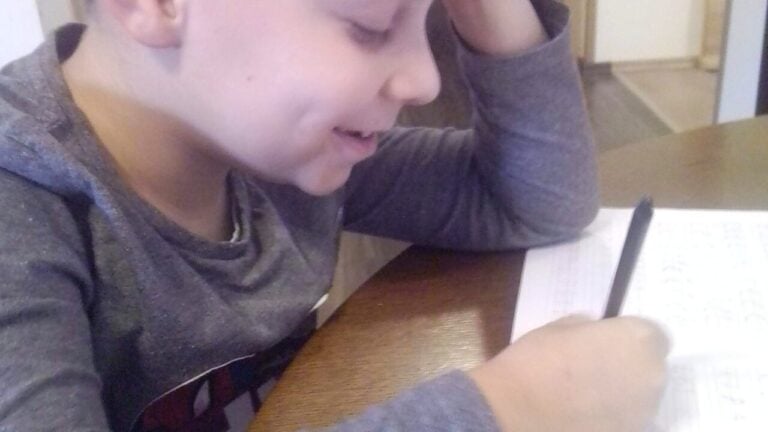
Our youngest had very poor handwriting, and because he was a slow developer, his fine motor skills developed later, which made pencil holding a challenge for him.
While he has overcome that challenge, handwriting was a struggle for a long time. Notebooking just gave us another opportunity in our school day to practice writing.
What I don’t do is make neat handwriting an issue. Again, I feel notebooking should focus on building listening and comprehension. It should be fun and relaxing.
3. It helps build comprehension skills
This is one of the reasons why I love notebooking.
I have found that dictation has helped our youngest son in reading comprehension and remembering what he’s read.
At first, I dictated to him something from our story or lesson and found that he would remember it after having written it down.
Later on, I began to have him copy sentences from what he read, and after a while, he was able to dictate from memory.
It was a progression that helped strengthen his reading comprehension skills.
Danika Cooley from Thinking Kids Blog encourages dictation in notebooking for younger grades.
4. It helps to track their progress
After only a short time of using notebooking, I saw progress in their writing and dictation skills. This progress is most visible in their notebooking and/or lapbooks.
Having this visual, tangible method to track their learning and progress has been so valuable…and it’s encouraging.
There are times when I feel discouraged and like I’m failing my children in a huge way.
All it takes for me is to go back and revisit where we were when we started, and see how far they’ve come to show me that I’m not only not failing my kids, but I’m giving them the very best education possible!
It’s relaxed.
It’s stress-free.
It’s fun.
It’s creative.
And they love it! What more could I ask for!!
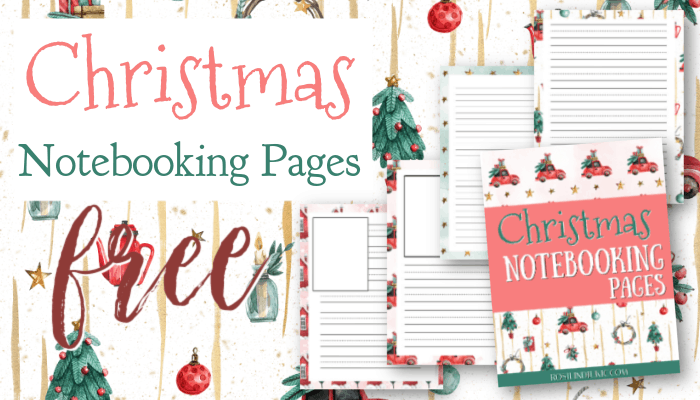
If you’d like to take a look at my free notebooking pages, you can visit my Notebooking Pages general page.
Many of my notebooking pages correlate with my unit studies.